
'Too exciting'
In which Henry acts out, and we go to the movies again

Deprived of his enemy, shrugged to a standstill
horrible Henry, foaming. Fan their way
toward him who will
in the high wood: the officers, their rest,
with p. a. echoing: his girl comes, say,
conned in to test
if he’s still human, see: she love him, see,
therefore she get on the Sheriff’s mike & howl
‘Come down, come down’.
Therefore he un-budge, furious. He’d flee
but only Heaven hangs over him foul.
At the crossways, downtown,
he dreams the folks are buying parsnips & suds
and paying rent to foes. He slipt & fell.
It’s golden here in the snow.
A mild crack: a far rifle. Bogart’s duds
truck back to Wardrobe. Fancy the brain from hell
held out so long. Let go.
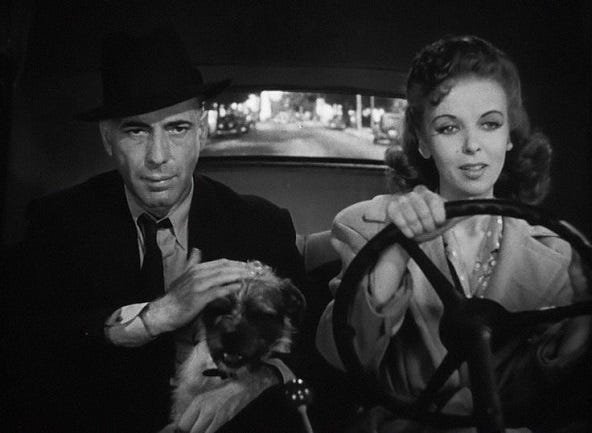
Preamble: Hello, friends. Here we are at the movies once more, in this case watching Humphrey Bogart in High Sierra (1941). Don’t say we never do anything fun together. This Dream Song is based very heavily on the film, so it is in the differences and the details that we will look for its significance. It is a more complex poem than it first appears; it is also chock full of interesting technique and, yes, brio. Brio and panache.
A note on the title of this post – it comes from DS53, when Berryman quotes T. S. Eliot: ‘I seldom go to films. They are too exciting’. Shortly after this Berryman quotes an unnamed novelist as saying
It takes me so long to read the ’paper […]
because I have to identify myself with everyone in it,
including the corpses, pal.
I find that desperately funny, but also dark. In a book much possessed by death, there are a lot of corpses for Henry to identify with, and one, dangerously, in particular. But here he is identifying with Humphrey Bogart, at least until the final lines, when the costumes (‘duds’) are ‘truck[ed] back to Wardrobe’. As always with Berryman, it is unclear where we are situated, if anywhere: are we watching the film with Henry, or watching a dream in which Henry is Bogart, or watching Henry use the film as a metaphor for his own situation, or … but it is, of course, impossible to say. The point is that Henry has chosen this film, and has used it to render a sensibility.
The film: There’s a lot to be said about High Sierra, and I will necessarily be concise, because we are here for Henry more than Humphrey. A notorious gangster, Roy Earle (Bogart), is sprung from prison by a dying villain who wants him to do one last job. Earle has a heart of gold, curing the lame and robbing the rich to help the poor, etc, though he is also quite handy with fists and revolvers. He hooks up with a gangsters girlfriend, Marie (Ida Lupino), and a dog, Pard, and briefly it seems they might have a future together. Alas, it all goes sideways, and he ends up pursued and cornered in the mountains, where he is shot and killed, to the dismay of both dog and woman.
For a fuller and richer treatment, see this essay. I wish we could linger longer on the film, which I have wastefully over-researched, but Parnassus calls us.
From the film:
Roy Earle: You know, sometimes when you’re out in the night and you look up at the stars, you can almost feel the motion of the Earth. It’s like a little ball that’s turning through the night with us hanging on to it.
Velma: Why, that sounds like poetry, Roy. It’s pretty.
Roy legs it fairly sharpish at the mention of poetry, and who can blame him, eh.
The poem: As a whole, it has much of the excitement we found in the final stanza of DS7 (‘… where Hoot / is just ahead of rustlers’ etc), the cowboy genre giving way here to the gangster flick, with both still celebrating the outsider as the hero, positioned against a corrupt culture, and at odds with the law. Barring the opening and closing lines, where the focus is entirely on Henry’s inner state, the poem hews closely to the plot of High Sierra, but with some interesting twists.
The music: Tight rhyme scheme, abacbc in stanza 1, abcabc in the others. This made it easier to learn; as did the semblance of progressive narrative. Rhythmic without ever settling: the iambic pentameter is there, for example the first line of the second stanza (‘if he’s still human, see: she love him, see’), but there are various metrical arrangements throughout. I have belatedly remembered the word ‘logaoedic’, which Merriam Webster defines as ‘marked by the mixture of several meters. specifically: having a rhythm that uses both dactyls and trochees or anapests and iambs’. I could have done with this word from the start, and will doubtless be deploying it frequently, with relish or recklessness, ‘going forward’.
Alliteration – ‘horrible Henry’ (echoing clearly back to ‘Huffy Henry’ in DS1) initiates a profusion of ‘h’ sounds: who, high, human, howl, Heaven, here, Hell, held. ‘W’, ‘f’ and ‘sh’ are also prominent. A couple of repetitions – repetitions of repetitions, interestingly – first, our old friend ‘see’ (see ‘To see, to see’), in a conjunction which I oddly failed to list in that previous near-exhaustive post; and then our old friend ‘come’ (‘come down, come down’) in a conjunction we will meet again in DS21, as I discuss below.
1) Deprived of his enemy, shrugged to a standstill
We noted last week the oxymoronic qualities of this book, and here we are again. You are ‘deprived’ of something you need. Henry, we understand from this, relies on antagonism. What he cannot cope with is indifference. (‘Shrugged’ can work either way here, presumably deliberately; the world’s indifference, or Henry’s.) We have noted Henry’s fear of indifference, and of being undifferentiated (‘reduce him to the rest of us…’, DS25). It comes to the fore in a number of poems, one of which is DS56 (‘Hell is empty …’) where Henry wrestles with a theory of Origen’s, that everyone will one day be returned to a state of grace, even the devil. Let’s just note for now that although we don’t, at this point, know who Henry’s enemy is, by DS13 we are told that ‘God’s Henry’s enemy’. And note also that in DS9 we are about to encounter both ‘Heaven’ and ‘Hell’.
But before we go any further, even our very first reading has immediately re-established for us a familiar Henry: thwarted, grumpy and unheroic. ‘Henry … with his plights and gripes’ (DS14).
2) Horrible Henry, foaming
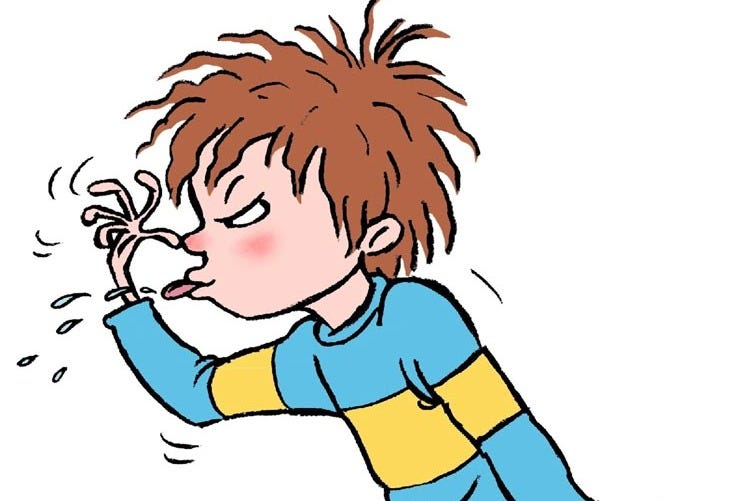
Impossible, I imagine, for UK readers at least, of several generations (either via their own childhood reading, or their children’s reading), to meet this phrase without thinking irrelevantly and irreverently of Horrid Henry, by Francesca Simon.
3) Fan their way / Toward him who will
My legal pal, who really enjoyed this one and wrote to me to say so, remarks:
Lines 2-4 are wonderful: "Fan ... who will" = "let them all come" which also = the roaring belligerent drunkard.
He is right: at first you imagine the sense will be conditional – ‘Fan their way who will [ X will nonetheless be the case] ’ – but in fact the clause is an entire sentence unto itself; bring it on. Again, an echo will be found in DS13 – ‘I couldn’t feel more like it’ – a piece of bravado sharply put down by his minstrel chum in that poem.
‘Fan’ nicely captures the spreading out of a search party, the casting of a net that will tighten: again, looking forward, DS56 gives us the Scottish word ‘tinchel’ – ‘A wide circle of hunters driving together a number of deer by gradually closing in upon them’.
4) The officers, their rest
‘Rest’ is a bit tricky, isn’t it? The rest of the crew? I am clueless. An echo of ‘arrest’? Dragged from their down time? Nothing quite works for me, I’m afraid.
5) With p.a. echoing
I had already noticed myself that the p.a. (‘public address’) features three times in 77DS; once when crows are heckling Henry’s lectures in India (DS24), once in the final poem when Henry ‘p.a.’d poor thousands of people’ about topics which they do not find as exciting as Henry does. But then I found the point had already been well made in an essay by Peter Campion titled ‘John Berryman’s Acoustics’ (2017):
One of Berryman’s favourite abbreviations, ‘p.a.’ for public address, here deserves attention. It shows up in Dream Song 24 when Henry lectures an Indian audience, as well as back in Dream Song 9, a poem remarkable for its own engagement with popular culture, electronic media, and state power: Henry’s mental anguish here finds an image of itself in the final scene of Raoul Walsh’s film-noir classic, High Sierra, when Ida Lupino speaks through a California state trooper’s microphone, attempting to talk Humphrey Bogart’s ‘Mad Dog’ Earl Ray [sic] down from a cliff. In all these poems, ‘public address’ suggests a parallel with the poet’s own acoustic art. After all, what does the poet do but address others through a conduit connecting collective and personal experience? And yet there’s also a certain embarrassment: ‘p.a.’ may suggest the eminence of the person speaking, but it also conjures those institutional authorities – the police, as well as academics – to whom people generally aren’t overjoyed to listen. In Berryman’s poems, p.a. systems often evoke a Kafkaesque tragi-comedy of entrapment within structures of power …
I think that final line is perhaps ‘going it a bit’, but it is definitely worth looking carefully at forms of address in 77DS; who is being spoken to, and how. I should also note, en passant, that Campion has made two different mistakes with regards to High Sierra: one when he calls Bogart’s character ‘Earl Ray’ rather than Roy Earle, thus inadvertently conflating him with the assassin of Martin Luther King; the other regarding Ida Lupino (see below).
6) His girl comes, say … she love him, see
The verve of the next few sentences perhaps obscures the distinct oddity of the word ‘say’. It half-rhymes with the repeated ‘see … see’, and operates similarly, grammatically. But ‘say’ frames what follows as a hypothetical; in a lengthy description of a dramatic scene, it breaks the frame, and suggests that we have some agency in how we deploy different ingredients. And the switch from that hesitant ‘say’ to the assertive ‘see’ explains why she has been deployed, both by the fictional sheriff and by the ‘makers’ of this scene. We will pull away again in the final lines, when actor and costume are invoked: but ‘say’ is an earlier foreshadowing of that move.
‘Conned in to test // if he’s still human’ is also a distinctive phrase. ‘Test’ puts us right back into the grimness of the preceding poem, with Henry as the abject object of impersonal forces; and putting his humanity in doubt renders him as a cornered animal (cf both DS56 and DS57). It is a bitter line.
7) Therefore … howl
Here is where the poem first diverges from the movie, though few commentators notice, possibly because they didn’t watch it. In High Sierra, the sheriff tries to persuade and even bully poor Ida Lupino into calling Bogart down, but she refuses. So the way in which Berryman positions the love interest is surely significant. What does it say about self-pitying Henry that he re-casts her constancy as weakness? And fancy extending the aura of the bestial to her, with the word ‘howl’. (I have said it before, but women do not fare well in 77DS: in many ways it is a sexist and even misogynistic text, and readers will differ as to whether that fact is in any way redeemed by the book’s remarkable honesty and self-laceration.)
8) Come down, come down
Hang on to this phrase – later in DS21, we will encounter it several times, ominously, possibly as a welcoming of death itself. Because, for all the cinematic energy and colour in DS9, and its several witty touches, it is suffused by violent death, whether witnessed or anticipated.
In a scene with Lupino, Bogart talks of the despair of prison:
you might as well climb up on tier two and jump off … Some of them did … Top of the cell block. It’s a 40-foot drop and you land on concrete. I saw a guy take a dive once. He made quite a splash.
Later Bogart, shot, falls from a mountain ledge. Come down. In the final lines of the film, Ida Lupino asks tearfully what ‘crashing out’ means and is told that it means ‘free’. In a wobbly voice, Lupino repeats the word in hesitant triumph: ‘Free. Free.’
Earlier in the film, another character tells Earle: ‘Remember what Johnny Dillinger said about guys like you and him … He said you’re just rushing toward death’.
Even without any knowledge of Berryman himself, and just focusing on Henry’s protracted wrestling with thoughts of death, this poem gains retrospective depth and darkness as the volume progresses.
9) Therefore he unbudge, furious
I tend to read the preceding lines in a comically stroppy way – by the time I have got to ‘she love him, see’ I am doing a mocking babytalk voice (much as a teenager might say ‘she wuv him’ in teasing mockery). And therefore he unbudge is excellent, the deliberate refusal and defiance rendered through the unorthodox un- prefix (see the last line of DS45 for this gesture to be given the full treatment). The repeated therefores – for her action, then for his; the action and reaction – capture something of the film’s inexorable tragic trajectory at this point (but for the fact that, as we have seen, in the film it is the woman who refuses, and the man who, lured by a fond and foolish dog, steps out and calls her name).
10) Only Heaven hangs over him foul
Heaven in stanza 2, Hell in stanza 3. Every chime in DS77 is intended. So while one reads them figuratively – Heaven for sky, Hell for suffering – the Christian backdrop is more than decoration. Again, let’s pocket this for later: after a witchy DS12, in DS13 God will make a dramatic appearance and will never quite quit the stage thereafter; in DS17 Lucifer is circling; in DS20 we are in a G. M. Hopkins pastiche with souls at stake. 77DS is packed with some pretty heavy theology, and its religiose language cannot be treated simply as colourful metaphor.
‘Only Heaven hangs over him foul’ is almost Shakespearean, surely? Once again Berryman is able to move nimbly between high and low registers; it never jars. This is harder to bring off than it looks, and Berryman is bringing it off repeatedly. There is a facility here, in the braiding of disparate voices, which may be part of what draws his fascinated readers. It achieves linguistically an equivalent of the e pluribus unum vibe which we have mentioned before – Henry as an unlikely Everyman – and which Henry also (see above) fears as a threat to his individuality.
11) he dreams the folks are buying parsnips & suds / and paying rent to foes
‘Suds’ – I did not know this before – means beer. Because of the foamy head, see. (A little chime with ‘foaming’ in line 2? Maybe.) I love that he rhymes it with ‘duds’, also hardly a familiar word. Did they come to him as a pair, or did one suggest the other?
The image here is of the poor folk in High Sierra, suffering during the Depression while the rich (‘foes’) exploit them. The foes are not Henry’s foes. He is ‘deprived’ of an enemy. So while DS9 carries with it the anti-capitalist charge of the film, something deeper and darker is going on with Henry, however sympathetic he might be to his fellow underdogs; just as Roy is in the film.
‘He dreams’ is interesting, just as ‘say’ was earlier. Roy, on the mountain, dreaming of the poor folk back in the town? Or Henry, in his distorted dream of being in the film’s scenarios?
12) He slipt & fell. / It’s golden here in the snow. / A mild crack: a far rifle.
Odd order, as my legal pal quietly notes; surely he should fall after being shot (as he does, in a slightly muffed piece of stunt work and cinematography, in the film). There is no visible snow in the film, though it is referred to. Snow occurs elsewhere in 77DS, most notably in the nightmarish DS28 (‘Snowline’), but also, for example, with reference to recovered trauma (‘One sign / would snow me back, back’) in DS30; and the Holocaust in DS41. Here it is also a harbinger of doom, but oddly welcome, a sleepy surrender. My legal pal certainly feels that: ‘He's glad. He wanted it’, pointing out that ‘golden’ is a highly positive adjective – ‘perfect’.
‘Slipt’ is another of those archaisms which serve, in my view, to make us aware (as ‘say’ did earlier) that we are in a composition. (Berryman doesn’t always do this, is the point: e.g., he uses ‘crampt’ for ‘cramped’ in DS11, but ‘slipped’ in DS15. Going archaic in 77DS is a conscious choice, a brushstroke that draws attention to itself.)
‘A far rifle’ – whenever I read this, I mostly feel that Henry and Bogart have become disentangled, and Henry is face down in the snow, while Bogart is shot a fair way off: Thalia and Melpomene, farce and tragedy. But it needn’t be that. It could be that Henry/Bogart has been shot from a distance; though he doesn’t end up in snow in the film. In the film, the shooter has cunningly climbed higher than Roy Earle, and picks him off from above; and the dog, the moll, and the sheriff swiftly run up to the body.
13) ‘Bogart’s duds / truck back to Wardrobe’
‘Duds’ means clothes – the word is still in use, but verging on the old-fashioned, surely. It can also mean forgeries, and things which function poorly. But here it clearly means clothes, and in the form of costumes; which are already forgeries of a sort. By this stage – with the accumulation of ‘say’, ‘dreams’, and ‘duds’ – I think it is clear that our experience of Henry’s cinematic dream of Bogartian anti-heroism is being deliberately disrupted, that we are constantly being made to step back and see the stagecraft.
Henry is identifying with a man who gets shot; Henry is partly welcoming death himself. These are preoccupations throughout the book, whether displaced (as here), shied away from (as we saw in DS6), traumatically rendered (as in DS34), vicariously felt (DS36) or faced up to (DS75-76).
14) ‘Fancy the brain from Hell / held on so long. Let go’
This was one of the passages I most loved on first encounter, and specifically wrote down, all that time ago. As a young person who had suffered repeated and frequent deep depressions from the age of 12, it ‘spoke to me’, as people say. The constant torment of one’s own sick thoughts; the desperate desire to be free of your own brain. I do not know if this is why Berryman drank: it is certainly why I drank. I wanted to annihilate my mind.
Compare DS30 – ‘Hell talkt my brain awake. / Bluffed to the ends of me pain’ – and DS57 – ‘To Hell then will it maul me?’ – and DS58 – ‘having brain on fire’. The brain in 77DS is often inflamed (‘brainfever bird’; ‘roiling & babbling & braining’), and those fires are always at some level the fires of Hell.
The repetition in ‘Hell / held’ is brilliantly done, an awkward brief tug and catch over the line break. And then ‘Let go’. What does it mean? A hopeful interpretation would be that the hellish brain can finally release its obsessive grip. But it doesn’t feel like that to me. In the context of High Sierra and Henry’s own associations, it feels like a welcomed death for an exhausted man. So long.
This week’s song: I was thinking of Kate Bush’s wonderful ‘There Goes a Tenner’, about a heist gone wrong, because of these lines:
Both my partners
Act like actors
You are Bogart
He is George Raft
That leaves Cagney and me
but have gone instead for Spear of Destiny’s ‘Never Take Me Alive’. Enjoy.
Thanks, Robert, for so generously sharing your piercing insights into the work of Berryman which has haunted me like a song without really knowing why. This week's was a cracker. So noir it hangs you upside down. Your musical choices are a further treat. Didn't know the bleak Spear of Destiny but the revolver I reached for was Don't Take Me Alive. The menacing squeal of the guitar, the opening lines of both verses, together with Donald Fagen's grimacing vocals: rock noir.