
'In the dark'
In which there are fewer questions than usual, but of greater weight

There were strange gatherings. A vote would come
that would be no vote. There would come a rope.
Yes. There would come a rope.
Men have their hats down. ‘Dancing in the Dark’
will see him up, car-radio-wise. So many, some
won’t find a rut to park.
It is in the administration of rhetoric,
on these occasions, that – not the fathomless heart –
the thinky death consists;
his chest is pinched. The enemy are sick,
and so is us of. Often, to rising trysts,
like this one, drove he out
and the gasps of love, after all, had got him ready.
However things hurt, men hurt worse. He’s stark
to be jerked onward?
Yes. In the headlights he got’ keep him steady,
leak not, look out over. This’ hard work,
boss, wait’ for The Word.
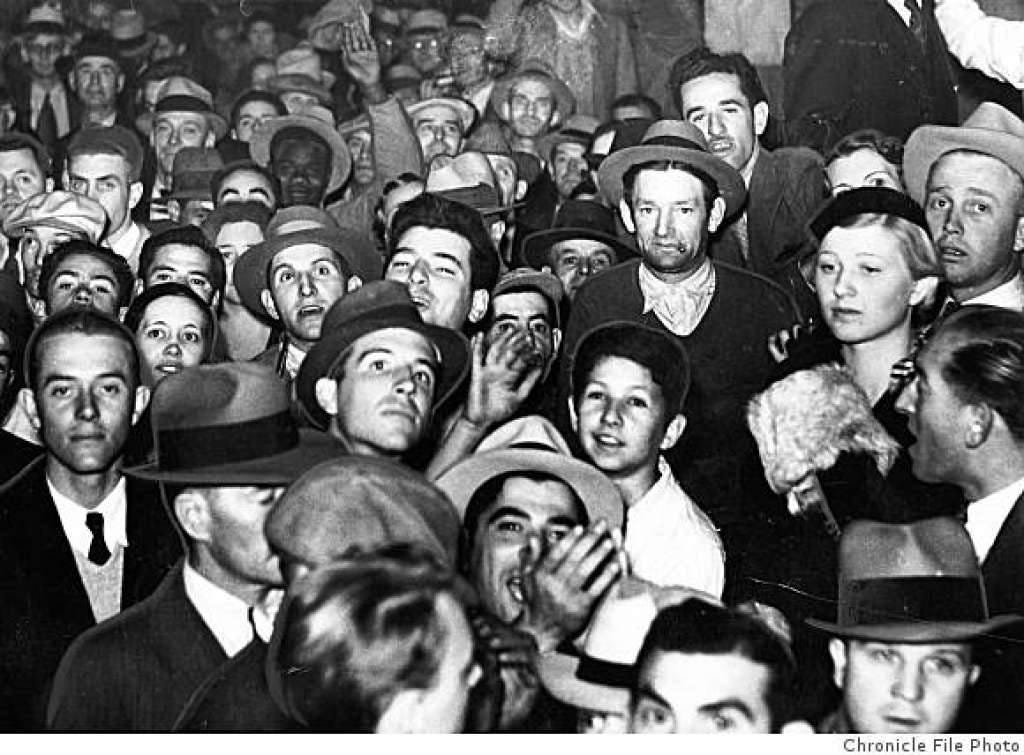
Preamble: This poem will not require the sort of line by line analysis that others so far have; and not all of the subsequent poems will do, either. Despite moments of opacity, the subject is clear – a lynching in America – and what we need to think about is the treatment of that subject. The matter of Berryman, a white writer, using black voice in 77DS is fraught. The question of who has the authority to write about certain subjects is more fraught still. I cannot ignore my own vantage here, either. Readers will, I hope, forgive the absence of my customary levity this week.
My legal pal and I met for a drink this week, and we set about the poem together. He (regular readers will remember) is our innocent pair of eyes, coming at 77DS for the first time, unencumbered by any knowledge of Berryman’s biography or other distractions: he is also a voracious and properly thoughtful reader of both fiction and non-fiction, when unwinding from his legal labours, and has a fine, long-nurtured literary sensibility. (As teenagers, with university entrance exams looming, we gave each other tutorials on our then-favourite books of poetry: I gave him my account of Larkin’s The Whitsun Weddings, he gave me his account of Ted Hughes’s Crow.) His analysis of DS10 was very persuasive, and we differ only on minor details. (I want him to have the credit for much of what follows; I have been dithering, and distracted, and sometimes unhelpfully paralysed by various deadlines, obligations, anxieties, and I feel he has led me gently back to terra firma. ‘Without these friendships—life, what cauchemar!’)
The music: The rhyme scheme is tight, with a combination of ‘identical rhymes’ (‘rope’, ‘rope’), full rhymes (‘come’, ‘some’) and half rhymes (‘heart’, ‘out’). Good alliteration (the cluster of k’s in ‘stark’, ‘jerked’, ‘work’) and assonance (e.g., ‘thinky’, ‘pinched’, ‘sick’, ‘trysts’). Repetition – ‘vote’, ‘rope’, ‘men’ – which backs up a propulsive rhythm. The identification of aesthetic features has never seemed so trivial though, I confess.
The poem: The poem is unusually clear in its subject matter. ‘Strange gatherings’ (a conscious echo, surely, of Billie Holliday’s ‘Strange Fruit’); a vote which isn’t a vote (the kangaroo trials); the rope; the cars; the headlights. Re: the cars – my friend and I only disagree about one detail: he finds it indisputable that the poem’s victim is dragged to death by one of the cars. He is thinking of the horrifying and relatively recent case of James Byrd, which you can follow the Wikipedia link for if you have a strong stomach. Byrd was murdered in Texas 1998 by two white supremacists, Lawrence Brewer, and John King, who ‘are among the few white men to be executed for killing a black person in Texas since the death penalty was reinstated in the 1970s’. And dragging was indeed a method of lynching historically too:
A common perception of lynchings in the U.S. is that they were only hangings, due to the public visibility of the location, which made it easier for photographers to photograph the victims … Lynching victims were also killed in a variety of other ways: being shot, burned alive, thrown off a bridge, dragged behind a car, etc.
Berryman is not necessarily thinking of a specific case, and the sheer volume of cases which he would have been aware of is a grim fact in itself, but I wonder (Outer Resources) if, because it occurred in Minnesota, latterly his home state, and involved headlights, the Duluth lynchings of 1920 would have had a special resonance for him:
After Clayton, Jackson, and McGhie were killed, Clayton’s body was cut down or fell to the ground. The crowd gathered around their lifeless bodies, then illuminated them with car headlights and posed Clayton’s limbs. Dozens of white men stood smiling for a photograph, which was made into postcards sold as a souvenirs.
(Minnesota is still no stranger to organized racial terror a century later.) Regardless of the detail, Berryman is offering a description both particular and general, of a man being jerked by a rope, toward his death, in front of a crowd of men.
The treatment: There is a strong sexual undercurrent to the violence. At times Berryman could be describing a dance as much as a lynching: ‘Dancing In the Dark / will see him up’ could mean ‘the music gets him up on his feet’, or ‘the music will accompany his hanging’; ‘a rut to park’ evokes not just the wheel-furrowed mud, but also sexual rutting; ‘trysts’; ‘gasps of love’. It is interesting that in a poem very much about ‘men’ (‘Men have their hats on’; ‘However things hurt, men hurt worse’) the pronoun ‘he’ is so ambiguous here. ‘His chest is pinched’ could refer to the guilty onlooker or the terrified victim. ‘Often … drove he out’ cannot refer to the victim. And when we come to ‘The enemy are sick, / and so is us of’ (i.e., ‘we’ are ‘sick’ of the enemy, who is morally sick), the ‘we’ can apply as easily to the killers, convinced they are delivering ‘justice’, or the civil rights protesters of the era, angry at the disease of racism. But ‘he's stark / to be jerked onward’ is the victim.
I wonder if the flickering of the pronoun between victim and spectator deliberately raises a question about complicity and witness which then, inevitably, also confronts the writer and reader. This is one of the defences sometimes made of Berryman’s use of black voice; that it is precisely calculated to raise questions of complicity and guilt in a book which several times addresses American racism, and with unusually specific (for this book) references. In DS60:
Afters eight years, be less dan eight percent,
distinguish’ friend, of coloured wif de whites
in de School, in de Souf.
I quote those lines in particular because they bear on the question of waiting (see lines 17-18). The reference in DS60 is to Brown v. Board of Education (1954), but in DS2 and perhaps here (the mater of ‘a vote … that would be no vote’), we are looking at enfranchisement, legal v actual: the stark gap between the promise of the Fifteenth Amendment and the reality for black voters would not begin to be addressed until 1965, the year after 77DS was published.
‘The administration of rhetoric […] not the fathomless heart’. Rhetoric, rather than justice, one notes. My legal pal thinks this passage is very much about the ways in which something evil is rationalised; that ‘the administration of rhetoric’ is a pivotal and acute phrase. Also the phrase ‘on these occasions’ , conveying a horrific aura of the routine (and arguably delivering a third meaning for ‘rut’, above). He also points out the use of the passive voice in the opening lines, a rhetorical manoeuvre famously used by people shying away from responsibility, and engendering here a sense of inexorability. ‘The thinky death’ – the death of proper thoughtfulness? Or the suppression of the emotional via rationalisation? (Note, conversely: ‘This is not for tears, / thinking.’ in DS29.) ‘The gasps of love’, on such a reading, might allude grotesquely to the allegations of rape that often formed the notional excuse for the murders.
It is certainly arguable that the steadiness and the rhetoric of the poem itself contribute to a self-reflexive, or even self-critical, undercurrent. The cool tone delivers a real sense of horror by the end, which is arguably more powerful than an overtly emotional treatment would have been. The final shift into minstrelsy becomes agonizing here, that ‘Boss’ recognizing the subordination of victim and complicitous bystander alike to the leaders of the mob. The appalling and understated acceptance of the grotesque, by all parties.
Which man, by the end, victim or conscious-stricken witness, needs to ‘keep him[self] steady’ and ‘leak not’? (That clinical ‘leak’ horribly poised between tears and terrified incontinence.) ‘Look out over’: the elevated victim, looking out over the crowd; but also, surely, evoking ‘look over Jordan’, from ‘I looked over Jordan, and what did I see / Comin' for to carry me home’? Which Word is being awaited; the signal to begin the execution, or the ambiguous deliverance implicit in that upper case W?
I’ll leave this here, if I may, with the obvious song.
Brilliant. Utterly absorbing. Thank you.
Well done, all around. I'm with you on what kind of lynching is going on here. Attending to contrasts (the men's hats down versus the speaker being jerked up, e.g.) helps, as well as the idea of so many parked spectators, lights on and radios blaring. The images of treed "coons" elsewhere, by the way, resonate horribly with this one. Another contrast: the pinched chest versus the fathomless heart, which makes me think of the "control-less core of the human heart" in Byron's DJ. Perhaps worth considering: Henry in or observing similar kinds of situations in #s 8-12.