
'In business'
In which we wrestle with God, and corner a rat

God bless Henry. He lived like a rat,
with a thatch of hair on his head
in the beginning.
Henry was not a coward. Much.
He never deserted anything; instead
he stuck, when things like pity were thinning.
So may be Henry was a human being.
Let’s investigate that.
… We did; okay.
He is a human American man.
That’s true. My lass is braking.
My brass is aching. Come & diminish me, & map my way.
God’s Henry’s enemy. We’re in business… Why,
what business must be clear.
A cornering.
I couldn’t feel more like it. — Mr. Bones,
as I look on the saffron sky,
you strikes me as ornery.
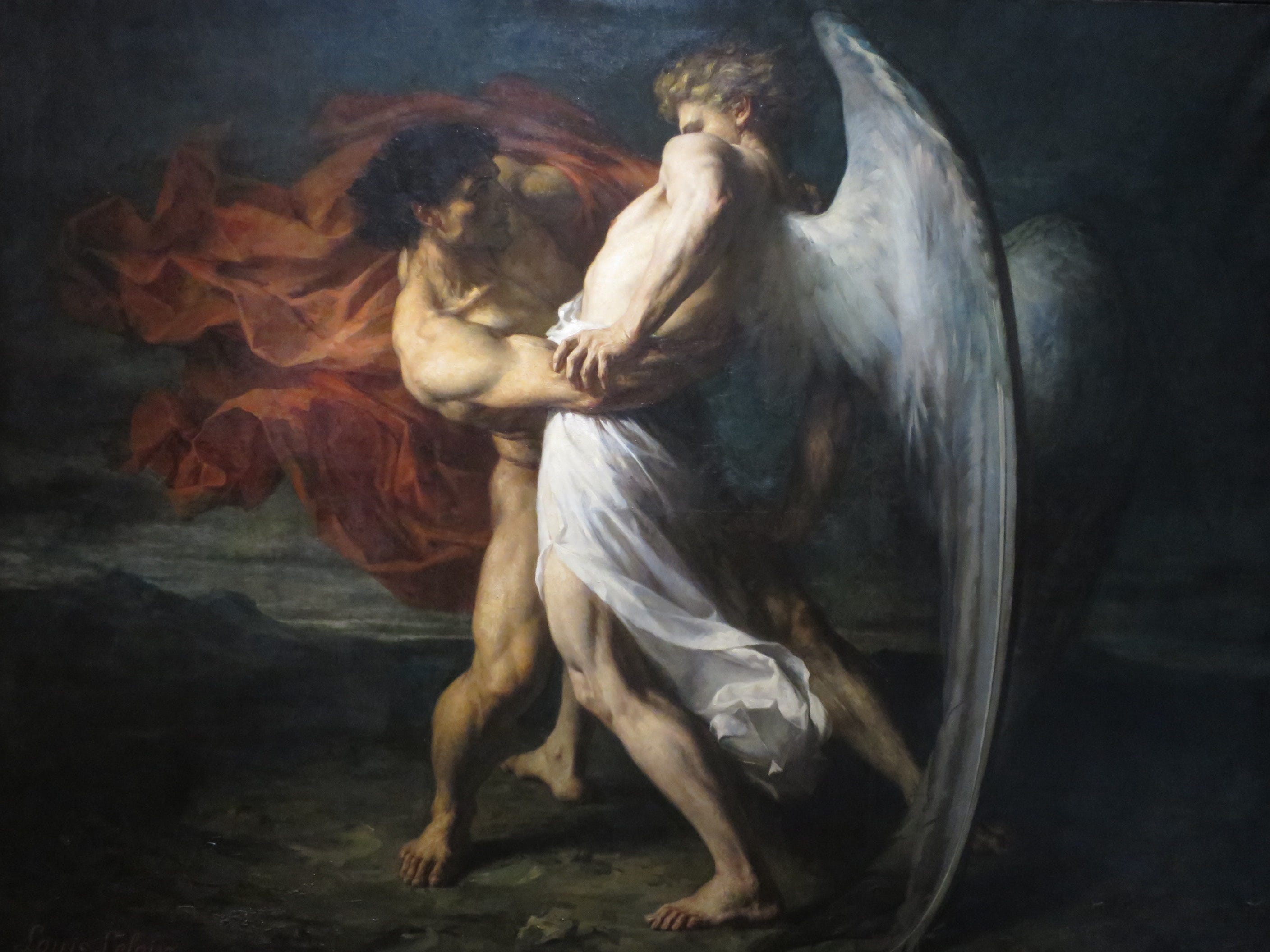
Preamble: ‘We’re in business.’ Dogged readers will recall that this entire Substack began with a quotation from DS13. It is a crucial poem. Despite the inconsistent use of markers – the absence of either quotation marks or dashes, until the final minstrel interjection – it is a poem of dialogue, a wrestling between various positions and feelings. Much of its agony is characteristic of the rest of the book, but some of it is performed here for the first time. Certainly, ‘God’ has only appeared once before, fleetingly (‘At odds wif de world & its god’, DS5), but God – as the book understands Him – is a significant, even central, feature of 77DS.
The music: As in DS11, there is a rhyme scheme in which two lines in each stanza do not rhyme with each other. Internal rhymes – rat, thatch, much. Braking, aching. Lass, brass. Lots of ‘in’ and ‘ing’. Repetitions: Henry (four times), God (twice), human (twice). The poem is heavier on assonance than alliteration, though there is a lovely hum of m’s across ‘Come and diminish me and map my way’. The rhythm never settles. Much of the poem’s vigour comes from the drama of its voices, the contradictions and qualifications of its exchanges.
God, and other people:
‘God bless Henry.’
‘Of now done darkness I wretch lay wrestling with (my God!) my God’
(‘Carrion Comfort’, Gerard Manley Hopkins)
‘besides a sense of others, my God, my God,
and a jealousy for the honour (alive) of his country’
(DS26)
Berryman was a massive G. M. Hopkins fan, noting admiringly his ability to commingle ‘vigour & fatigue, confidence & despair, the elegant & the blunt, the bright & the dry’. (Combinations which we also, and not coincidentally, find in 77DS.) His love of Hopkins is attested to in the scholarship, but even if we stick solely within Inner Resources it is quite obvious: there are some flagrant allusions or pastiches in 77DS, and I would argue that there is also homage even (especially) at the syntactical level.
And, like Hopkins, Berryman dramatizes religious doubt, the wrestling with despair, a sense of wanting a relationship with God but feeling estranged. There are three really outstanding poets of religious doubt in the English canon – George Herbert, G. M. Hopkins, and Geoffrey Hill – and they all share the same initials. Can we add to that list the name of … Giovanni Henryman? (No.)
There are times in 77DS when Berryman quite consciously uses a phrase that sounds colloquial (for example ‘my God!’ in DS48, and ‘Christ!’ in DS46) but swiftly reveals it to have been sincerely theological. So it is with ‘God bless Henry’. It seems a merely fond and chatty opening, and is almost immediately forgotten in the welter of half-defended abjection and objectification that follows; but in stanza 3 it is retrospectively shown to be a real plea. For the phrase ‘God’s Henry’s enemy’ arrives unexpectedly, forcefully, as a revelation: and it surely means that the prayed-for blessing has been withheld or denied. The seriousness of the line is immediately reinforced – ‘We’re in business’. As if to say: finally, it’s in the open, let’s go. It is as if the shadowy persecutory agents of the preceding poems are now unmasked. We have seen the enemy, and it is God.
Plenty of commentators have related Henry to the Biblical figure of Job, and a number have explored the relevance of Kierkegaard. Even if Kierkegaard wasn’t explicitly referenced (in DS53) I would have wanted to mention him; the existential dread and despair of DS77 feel very Kierkegaardian indeed. Uncharacteristic digression: As a teenager I studied, for A-level, ‘Liberal Protestant theology from Schleiermacher to Bultmann’. A remarkable course, I now realize. The man who taught it was a chaplain who had studied philosophy, and fearlessly introduced a bunch of 16-18 year-olds to Hegel, Kierkegaard, Nietzsche, Feuerbach, Tillich, Buber, and so on, and right up to Don Cupitt and Mary Daly. What an education: way over our heads, but of ceaselessly growing long-term value for me. (In retrospect, only one teacher at that school has had more of an impact on me: an English teacher who I know is reading this Substack, and to whom, neither for the first nor the last time, I would like to offer my profound gratitude and admiration.) Anyway, the whole tendency of that theological tradition, as far as I could make out, was to reinterpret Hell not as a place but as a state of estrangement.
Furthermore, the phrase ‘God bless Henry’ also invokes the famous song ‘God bless America’. Henry, as we have seen, and will see repeatedly, is sometimes Everyman (‘He is a human American man’), and is nearly always unhappy with that fact (‘diminish me’). Henry’s ambivalence about his country and what it represents, and his ambivalence about enjoying a sense of belonging while maintaining his individuality, are hard to disentangle from his sense of being unreconciled with God. I think this is precisely what Berryman portrays in 77DS: the hellish brain of a man estranged from both God and humanity.
To Hell then will it maul me […]?
I dare say not.
I don’t thínk there’s that place
save sullen here, wherefrom she flies tonight […] (DS57)
The first mention of God in the book, as we noted above, is the line ‘At odds wif de world & its god’ in DS5. World and God are often proximate in 77DS, just as brain and Hell are. At his most abject, Henry feels less than human (a word used seven times in 77DS). Hence, in defending himself, there is an emphasis on sticking around, not deserting, hence pity: things that connect Henry to other people. So, maybe (or ‘may be’ as he pointedly has it) he can become a human being. (Ophelia, in Hamlet: ‘Lord, we know what we are, but know not what we may be’.)
And other animals: Speaking of not feeling human… ‘He lived like a rat.’ The longer I have thought about it, the more this line has intrigued me . ‘Like a rat’? What does he mean? Which particular facet of a rat’s habitat or behaviour or life cycle is he referencing? Squalor, poverty, cunning, survival? (Communal living?) There is surely some sense of untrustworthiness, the resonance of ‘rat’ as a betrayer, a low-down, dirty rat; hence the quick qualifications, ‘not a coward’ and ‘never deserted anything’. But if he is not that sort of rat, what sort of rat is he? And though the question seems to be set aside, it arguably returns later.
‘With a thatch of hair on his head / In the beginning’: We linked hair-loss to castration in DS8, but here I think we can eschew the Freudian. It is simply age, surely; he had a lovely thatch of hair earlier, but now… (Not, one notes, ‘from an early age’ or ‘in his youth’, but the more calculatedly biblical ‘in the beginning’. ) And it’s not sudden hair loss (in DS8 the hair was decisively ‘halved’), but slow; the word ‘thinning’ in line 6 is applied to ‘pity’, but without doubt is meant also to link back to ‘hair’. This is a poem not of abrupt severance but of gradual diminishment.
Let’s investigate that: At first, it is all in the past tense, rather strangely, as if an obituary or an autopsy – ‘may be Henry was a human being’. But on examination he is a ‘human American man’. That examination introduces another voice, the impersonal and sinister voice we found in DS8, where it subjected Henry to indignities. Here it is simply and reductively wrapping Henry up, in the broadest identifying terms of nationality and sex, as on a passport.
What would a non-human or less than human American man be? In a book aware of racial inequalities and injustices, in a poem where the minstrel dialogue reappears for the first time since the lynchings of DS10, one answer to that question is surely ticking away underneath.
Outer Resources: Berryman later described Henry as ‘a white American in early middle age sometimes in blackface, who has suffered an irreversible loss.’ Shane Macrae, in his intro to Only Sing: 152 Uncollected Dream Songs, makes the astute remark that
With Henry’s verbal blackface, Berryman externalizes the racial anxieties of the white, mid-century American. And he seems to do so consciously. As seen above, in his introductory note to The Dream Songs, Berryman made a point of indicating that Henry is white—he wanted his readers to keep that in mind; in the context of the introductory note, he did not allow whiteness to be a default position …
Has anyone seen my screwdriver? ‘My lass is braking. / My brass is aching’ suggests the usual sexual anxiety, and chimes with the lines I quoted from DS57 above (‘wherefrom she flies tonight’), which continue ‘retrieving her whole body, which I need’. As we have seen from DS1 onwards, ‘world’ and ‘lover’ are constantly confused in 77DS; and so, in poems otherwise concerned with his relation to God and humankind, horny Henry is still bothered enough to worry in passing about not getting laid.
There is, though, another reading of these lines in the work of [Legendary Chief Berrymaniac] John Haffenden; a reading, I confess, which I am utterly unconvinced by; or rather, I am quite sure it is what Berryman meant, but I am equally sure that no innocent reader could see it that way. But, since we’re ‘here’, let’s do it:
Outer Resources:
My lass is braking. My ass is aching. (ll. 11–12)
Social and scientific research is satirised by allusion to the story of a man from Hamburg in Germany (although Berryman always associated the story with Unter den Linden) who sat contemplating his navel; eventually, unable to resist his enquiring mentality, he applied a screwdriver to the object of his gaze, whereupon his ‘ass fell off!’
[…] The very idea of Henry being a ‘human American’ is mocked by association with the story of a German whose investigative mind makes a machine of him. Berryman diminished his original phrase ‘my ass is breaking’ to the doggerel of the finished version in order to enforce the imprecation.
John Haffenden, John Berryman: A Critical Commentary (1980)
I’m sorry, but no reader even if they knew that story, could make that link. Even if ‘ass’ had not become ‘brass’. You need at the very least a screwdriver and a navel for this to be an allusion. A far better interpretation is the one I provided. I am, of course, open to others.
Fighting talk: ‘Come and diminish me and map my way’: To me, it is quite obvious that Henry does not mean this. It is weary sarcasm. Every fibre of 77DS suggests that even at his most beleaguered, Henry always has some fight left in him: and so the last stanza will prove. (In DS25 there is a very similar version of this in which Henry again sarcastically ventriloquises the enemy – ‘wipe out his need. Reduce him to the rest of us’ – and the parallels do not end there.)
‘Cornering’: as I have said, repeatingly, Henry is often trapped, encircled, cornered, etc; and especially in the poems leading up to this one. ‘Cornering’, surely, is meant to return us to ‘rat’, and the common image of a cornered rat for someone who, trapped, will fight with great ferocity. By using this precise word, Henry conjures once more some cinematic bravado, Bogart in High Sierra in DS9, the ‘weary, daring man’ in DS12. Hence the tough-guy snarl of ‘I couldn’t feel more like it’.
But this poem is an argument, and here comes his minstrel friend Tambo to deflate him: ‘As I looks on the saffron sky / You strikes me as ornery’. ‘Ornery’ is a perfect word, by the way, with its origins in the word ‘ordinary’ before it semantically drifted, via class snobbery, from ‘common’ to ‘low value’ to ‘lazy’ to ‘stubborn, difficult’ etc. The implication is that Henry is both difficult and (merely) ordinary. And the sky – as we saw in DS9 (‘only Heaven hangs over him, foul’) – represents the overwhelming and inescapable and dwarfing context for wretched Henry’s rebellious wrestling. That is, the whole poem has vivaciously performed a dramatic push and pull between absorption and alienation, with Henry doing most of the voices: but Tambo’s quiet put-down at the end gently mocks even that self-dramatization.
Outer Resources: I have just been reading – a perfect birthday gift from my pal the Contessa – Olivia Laing’s wonderful book The Trip to Echo Spring, a treatment of six alcoholic American writers. At one point she notes that Berryman’s writing in his unfinished novel Recovery suggested a greater degree of self-knowledge than the man himself was actually capable of:
Not everything about Alan Severance is drawn from life, and part of his power as a character derives from the ironic distance between his perspective and the reader's – which implies that Berryman possessed more insight into the disease than his stand-in […]
In John Haffenden's compassionate and exacting biography of Berryman, he points out that one of the ways in which Recovery parts company with the poet's lived experience was in his relationships with the other inhabitants of the ward. Alan Severance is generally well liked, though at times his educated diction and self-important claims, delivered at a roar, repel his fellow patients. They think he’s arrogant and deluded, but that’s par for the course and many of the sweeter scenes involve him engaging warmly with the others.
In reality, this wasn’t quite the case […]
And that, my friends, is exactly why I prefer to stick with Inner Resources, and why 77DS is a brilliant work of art despite the man who created it.
The song: I do hope y’all are listening to these each time, they are an important part of the, ahem, interactive visitor experience. Anyway, this one is perfect. I will rarely mention the later Dream Songs, for reasons covered in my first post, but in Dream Song 238 Berryman writes ‘Perhaps God is a slob’, and you’ll see why I have broken my own rule when you hear this (possibly forgotten?) 90s hit.
Another astute reading, and I agree with you about Haffenden's idea. What I see actually would work well with your sense of "horny Henry": "Brass balls" is what I hear there ("Henry was not a coward. Much."), and when your lass is putting the brakes on things those are some brass that can ache. That is, the second sentence expresses the result expressed in the first sentence, and the double rhyme and identical syntax reinforce the connection.
Diminishment, by the way, will be even more vividly realized in DS14, as you probably already know.
My father, who was a salesman and thus an archive of jokes dad bad and otherwise, used to tell that story about the guy unscrewing his ass all the time. I submit this impartially on Haffenden’s behalf!