'Henry are baffled'
In which we enjoy the mystery, and a hoedown

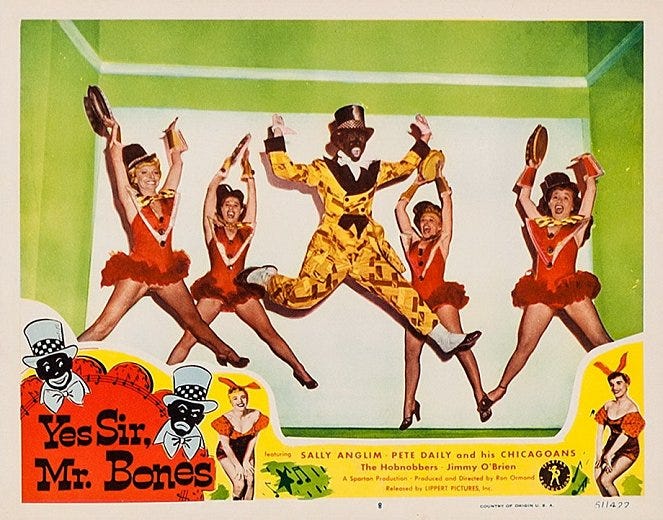
Preamble: a few remaining notes on DS1 before we (temporarily) take our leave of it. I have had, as Henry says, ‘the most marvellous piece of luck’. An old pal, unwinding from his labours in the Law, has grabbed a copy of 77DS & joined the journey: and being happily unburdened by any Outer Resources, he is thus able to share his unmediated immediate impressions. He summarises his first sense of DS1 thus:
1 his youth’s left him / his wife’s left him / his talent’s not recognised or he fears his talent has left him (but see 3.)
2 soon his life will leave him
3 still, he has songs to write on account of these matters
My pal then adds, rightly, of the blank space in ‘hid | the day, / unappeasable Henry sulked’
1 hid [for] the day (like: “hours, I waited”)
2 the day [his fate, events, etc] [was], unappeasable
I think those ambiguities are quite deliberate, a big part of the book’s ability to overlay two or more ideas at once, and this is an excellent take on how the mysterious blank space can be semantically effective. (And the ‘talent’s not recognized’ theory does help with the line ‘the thought that they thought they could do it’, which is otherwise very opaque. And does chime with some of Henry’s later gripes. ‘He … is … not … appreciated’, as Mark E. Smith would memorably croon. About himself.)
Also, another pal, who is in fact my actual brother, notes nicely ‘Not knowing the poem I was immediately struck by the gap after "hid" which seemed like a representation of a hiding place (thus hidden) but also carrying a metrical force – those opening lines would not be so arresting without it’. (So, both semantically and rhythmically effective. Not bad for something that isn’t even there.)
Anyway, to wrap up or summarise DS1, for now: certainly there has been a rupture – ‘once’ (we are told twice) things were good, as good as woolen lovers, or as singing atop sycamores, that good; but then something went (‘departure’); and now everything is very bad, and very sad – that sort of sad where the continued heedless activity of the rest of the world seems at best baffling, and at worst an affront. (‘How we hate you, busy, ordinary, undying …’ as Peter Reading wrote in C.)
Baffling... yes. The reader who turns from DS1 to DS2 in the fond hope that these questions might at least begin to be answered finds instead that Henry himself is – are! – baffled; and nowhere near as baffled as his readers, I would wager.
Big Buttons, Cornets: the advance
The jane is zoned! no nightspot here, no bar
there, no sweet freeway, and no premises
for business purposes,
no loiterers or needers. Henry are
baffled. Have ev’ybody head for Maine,
utility-man take a train?
Arrive a time when all coons lose dere grip,
but is he come? Le’s do a hoedown, gal,
one blue, one shuffle,
if them is all you seem to réquire. Strip,
ol banger, skip us we, sugar; so hang on
one chaste evenin.
—Sir Bones, or Galahad: astonishin
yo legal & yo good. Is you feel well?
Honey dusk do sprawl.
—Hit’s hard. Kinged or thinged, though, fling & wing.
Poll-cats are coming, hurrah, hurray.
I votes in my hole.
A reminder: For convenience, I will refer to the unnamed friend of Henry who calls him ‘Mr Bones’ (lines 13-15) as ‘Tambo’. Strictly speaking, this isn’t quite right, but I needed a convention, and this is it. Just a convention.
The music: As always, let’s pause to read it aloud, and to hear it. The five ‘n’ sounds in line 1, the ‘ee’ sounds in line 2, and then the extended hissy sibilance of ‘premises’, ‘business’, ‘purposes’. A tight rhyme scheme in stanza 1, progressively loosened thereafter. The iambic pentameters in the first lines of each stanza. The enjambments and internal rhymes (‘skip’, ‘strip’; ‘poll’, ‘hole’) which help to change that stately rhythm into skips and tumbles. ‘Require’ is stressed, unusually, on the first syllable – réquire – because that is a stress, not an acute accent, used, as Gerard Manley Hopkins uses it, to ask us to stress the ‘wrong’ syllable. (We will have to return to Berryman’s typographical peculiarities, at some point, because they are lamentably inconsistent. For example, I will – gladly – give £50 or a kilo of Stichelton, to the first reader who can convince me that Berryman’s choice of either the ampersand or the word ‘and’ has a consistent rationale on each and every occasion through 77DS.)
The minstrel voice – the voice of a white performer crudely representing a stylised and insulting version of blackness – how are we going to read that out loud? It was awkward even when Berryman wrote it. It is magnitudes more awkward now. Outer Resources: he used to ask Ralph Ellison for advice on his rendering of ‘Afro-American speech’. Ellison later remarked:
During the period he was writing Dream Songs I grew to expect his drunken (sometimes) telephone calls, in the course of which he’d read from work in progress…. I can’t recall how many such calls there were, but usually he wanted my reaction to his uses of dialect. My preference is for idiomatic rendering, but I wasn’t about to let the poetry of what he was saying be interrupted by the dictates of my ear for Afro-American speech. Besides, watching him transform elements of the minstrel show into poetry was too fascinating. Fascinating too, and amusing was my suspicion that Berryman was casting me as a long-distance Mister Interlocutor—or was it Mister Tambo—whose temporary role was that of responding critically to his Mister Bones and Huffy Henry.
This controversial side of the Songs will receive careful and focused attention another time. For now, let’s just register the shock of it. The grammatical and syntactical smoothness of DS1 (however opaque its meaning) has been replaced by something far more unorthodox, disruptive, discomfiting. But even if the grammar weren’t awry, and the spelling weren’t at times clownish, and the racial aspect weren’t so unsettling, it would still have been a very tough poem to make out in 1964. (And even tougher for me, a non-American, in 2026.) Seriously: what is this poem about?
The poem
Title: Big buttons, cornets: the advance
Dedicatee: ‘The second Song is dedicated to the memory of Daddy Rice who sang and jumped “Jim Crow” in Louisville in 1828’.
In an earlier post we discussed the book Tambo and Bones, a history of minstrelsy from which Berryman drew one of his epigraphs. Here’s a flavour of the performance conjured by the title and dedication in DS2:
Another feature of minstrel performances was the band and the street parade. Whenever the minstrels came to town, their arrival was heralded by a street parade, in which the “silver” or “gold cornet band,” gorgeously attired in colorful coats and trousers, big brass buttons and striking hats, led the procession through the streets of the town to the theatre, followed by the entire company, perhaps in long Prince Albert coats or swallow-tails, with fancy vests or colored lapels, and high silk “plug” hats.
We’re off.
1 ‘The jane is zoned’
‘Jane’ means ‘woman’. (OED, US slang: A woman, girl, girlfriend.) Hence ‘Jane Doe’. I can find no other meaning.
‘Zoned’ has a number of possible meanings: 1. Located in a zone or region of the celestial sphere; 2. Wearing a zone or girdle. Hence, virgin, chaste. 3. Characterized by or arranged (naturally) in zones, rings; 4. Arranged according to zones or definite regions. 5. Town Planning. Designated for a particular type of use or development.
A later meaning – Of a person: intoxicated by drugs or alcohol – is not attested to by the OED before 1971, but is surely an option.
So, the most obvious meanings are ‘the woman is chaste’ (and given the later lines, including ‘one chaste evenin’, this is promising), and possibly ‘the woman is high’. We would not immediately assume that ‘zoned’ in its town-planning sense was meant. And yet the following lines are very much ‘town-planning’ words: ‘no nightspot here, no bar / there, no sweet freeway, and no premises / for business purposes’.
So is ‘jane’ a metaphor for the town? Or is the town a metaphor for a woman, with the nightspot, bar, sweet freeway, etc being, through innuendo, euphemisms for body parts out of bounds? I am reminded of Maria in Twelfth Night saying to Andrew Aguecheek ‘bring your hand to the buttery-bar and let it drink’. Until I saw a performance in which she placed his hand on her breast, I had perhaps naively not appreciated the innuendo.
That ambiguity is further complicated by the electoral references in stanza 3 (‘poll cats […] I votes’), because bars were indeed closed on election day in most parts of the US in the 1960s. And for decades afterwards too. Indeed, I now gather, from languid Googling, that there are US states (and Latin American countries) where this is still the case. (As if people might make even worse decisions because they were shitfaced, eh. )
So, is Henry after a drink, or a date, or both?
2 ‘Have ev’ybody head for Maine […] ?’
I do not know why ‘Maine’ has been chosen here, nor how far away it is, since we have no been given a current location for Henry. Were the bars open in Maine on election day? My idly cursory researches so far suggest the opposite.
3 ‘Utility-man take a train’
Apparently a ‘utility man’ is a versatile fellow, capable of taking any role in a baseball team. But I note that it can also mean ‘utility actor’, which is glossed as ‘An actor of the smallest speaking-parts in a play’. I would welcome transatlantic input here.
4 ‘arrive a time when all coons lose dere grip / but is he come’? I took this sentence as meaning simply ‘a time always comes when we lose our grip; has that time come for me’? I have see it suggested that there may be a religious meaning (‘has He come again?’), and though that doesn’t work for me personally, there are certainly later lines in the book that chime. 77DS has a hefty theological component, and we will have to devote some attention to it when the time arrives.
The word ‘coon’, OED:
3 A stereotype or caricature of a black person formerly common in minstrel shows, vaudeville acts, and early cinema, typically portraying African American people as lazy, ignorant, and clownish. Also: a singer, actor, or entertainer who performs in such a role, esp. professionally (now chiefly historical).
The word ‘coon’ is used four times in 77DS, but in one instance, in DS57, an apostrophe indicates that it is a shortening of the word ‘racoon’:
I recall a ’coon treed,
flashlights, & barks, and I was in that tree[…]
I fell out of the tree
I mention this now in case the line ‘all coons lose dere grip’ is meant to chime in some way with Henry in DS57 as a ‘treed’ racoon (coon hunting is a sport in which trained dogs chase racoons up trees; formerly, so they could then be shot; latterly, for the fun, with the racoons going free) who loses his grip, and falls from the tree. It could be unintended, coincidental. But we are approaching 77DS as if every word is a decision, and as if the whole book coheres. That is the compliment we are paying it.
5 ‘Hoedown’
As discussed in a previous post, the hoedown was an integral part of the minstrel show:
By 1850, the form of the American minstrel show had become immutably fixed, as far as the minstrel semi-circle first part, and a second part variety bill, called the olio, were concerned. The last act in this olio, or second part, in the early days represented a genuine, hilarious darky “hoe-down” in which every member of the company did a dance at the center of the stage, while the others sang and vigorously clapped their hands to emphasize the rhythm.
6 ‘ one blue, one shuffle … Strip, / old banger, skip us we, sugar’
No idea. I do assume that they refer to aspects of the dance. I do not believe they have anything to do with striptease (see digression below), though equally I don’t think the word ‘strip’ has been used carelessly; there is a deliberate summoning of the erotic throughout, even as it is thwarted and short-circuited. Whatever is happening (or not) is ‘chaste’, hence Tambo’s mocking epithets for Henry, ‘Sir Bones, or Galahad’, and the sarcastic amazement that ‘yo legal and yo good’. But the very emphasis on chastity, legality, and goodness cannot but make us aware that Henry would be happier with their opposites.
7 ‘Sir Bones, or Galahad’
Henry refers himself, or is referred to, by various names (‘Mr Bones’, ‘Bones’, ‘Friend Bones’, ‘Henry Pussycat’, ‘Henry House’), and is further described by sundry epithets (huffy, unappeasable, careful, bewildered, horrible, gentle, friendly, elongate and valved (!), industrious, affable, stuffy, lazy, shaky, somber, seedy, etc). The mocking medievalism of ‘Sir Bones, or Galahad’ will come to mind again when we reach DS58, which is camply packed with words like ‘Sire’ and ‘serf’ and ‘Avalon’ – ‘me feudal, O me yore’. We might as well be in Spamalot.
(Note: Dialogue in 77DS is marked off by an em dash. So in stanza 3, the first 3 lines are Tambo, and the last 3 lines are Henry. Mostly the dialogues are between Henry and Tambo. But not always – in DS17, for example, Henry is talking with the Devil.)
8 ‘you legal & yo good. Is you feel well?’
The law, and legality, and lawyers, are invoked frequently across 77DS, with Henry largely on the wrong side of them, and may well get a post of their own. In this particular instance, I have seen it suggested that ‘yo legal & yo good’ means Henry is married; but the main thrust is surely simply that Henry is not boozing and/or philandering, much as he’d like to.
9 ‘Honey dusk do sprawl’. Some readers take this to be an invocation of evening (‘perhaps comforting him with a poetic image of an urban dusk’ etc etc). In DS50, Tambo refers to ‘de roses of dawns & pearls of dusks, made up / by some ol’ writer-man’; indeed, traditional and worn-out poeticisms of this sort are often undercut or knowingly framed in 77DS. But at least one reader has seen a sexual meaning (see digression below), and, again, a deliberate eroticism is surely plausible.
10 ‘—Hit's hard. Kinged or thinged, though, fling & wing.’
‘Kinged’ – raised up? ‘Thinged’ – treated like an object? ‘Fling’? No idea. ‘Wing’? Ditto. Is it about agency – that ‘fling’ is being helplessly thrown, and ‘wing’ is propelling yourself? Why the apostrophe in ‘hit’s’? At this point, the poem has surely collapsed into chaos and incoherence. Make of it what you can.
11 ‘Poll-cats are coming, hurrah, hurray. / I votes in my hole’
Again, I have found no consensus on this. It firms up the election day vibe. There is a tension between a public or civic act of participation (‘I votes’) and a place of retreat or abjection (‘in my hole’). There is a certain sarcastic scepticism about the electoral process (‘Poll-cats are coming, hurrah, hurray.’) Given that the question of race has been explicitly introduced via the minstrelsy in this poem, the theme of enfranchisement is surely pointedly significant? The 24th Amendment (1964) and the Voting Rights Act of 1965 were not yet in place a the time this poem was written.
When I try to figure out the meaning of this line, my mind ranges over the wide variety of meanings for ‘hole’: a pit, cave, den, hiding place in the earth; a burrow; a hiding place, a secret room; a dungeon or prison-cell; a small dingy lodging or abode; a position from which it is difficult to escape; a fix, scrape, mess; the orifice of any organ or part of the body; the mouth, the anus.
I wonder if Berryman would have appreciated the unforgettable Jesus & Mary Chain lines ‘God spits / On my soul / There's something dead inside my hole’.
*
A digression about sexual references
Just a quick one. Sometimes horny Henry is explicit about his lusts (and most noisily so in DS69 – where the frankly puerile choice of number is possibly not Berryman’s proudest moment), but sometimes there is just an aura or frisson of the erotic, and you cannot be quite sure. Is it you, or is it him? For a long time, I took DS5 to involve a little frottage on a flight (‘ … his thought made pockets & the plane buckt. / ‘Parm me, lady.’ ‘Orright.’) but I have had second thoughts lately.
It’s possible, see, to overdo this. (A woman walks into a bar, and orders a double entendre. So the barman gives her one.) I have seen more than one academic suggest that the phrase ‘hard on the land wears the strong sea’ in DS1 is meant to rouse in us thoughts of a ‘hard-on’. While I can’t rule it out, I’m unconvinced. (‘Put it away please, sir’, as I sometimes murmured while reading Craig Raine.) Sometimes the cigar is just a cigar, etc.
So similarly, I came across a reading of DS2 which argues essentially that Henry, having failed to get off with ‘the jane’, is now pursuit of erotic dancers instead:
The voice of the first stanza tells Henry that the “jane” Henry is after is off limits while Henry—all of his fractured selves—“are” confused that he should be limited in this way. It is literally night time, “utility man take a train?,” but Henry is also in a moral darkness as he is attempting to “get” a girl. The voice of the second stanza seems to be tempting Henry to lose his “grip” by getting this girl to dance, strip, and go to bed with him. When the first voice returns in the third stanza, he seems to encourage Henry, who is “legal”—white—and “good,” to just take the girl when he chimes “Honey dusk do sprawl.” The second voice responds graphically, referring to his genitals—“Hit’s hard”—while cheering for the “poll-cats” who not only relate to the voting motif because of the play on “poll” but also remind the reader of actual strippers who simulate sex, and goads Henry to not intellectualize his choice but make it based on his physical desire.
I’m really not convinced. This reminds me of an excellent A-level student, the daughter of a pal, who, finding the word ‘hoeing’ in a Ted Hughes poem and being wholly and understandably ignorant of its agricultural meaning, made a point about disrespectful language and womanising.
The late Michael Donaghy used to maintain that a man had earnestly explained to him after a poetry reading that Frost’s poem ‘Stopping by Woods on a Snowy Evening’ was about bestiality. (‘My little horse must think it queer / [...] He gives his harness bells a shake / To ask if there is some mistake’). Great gag though that is, I somehow doubt the encounter really happened. (Between Donaghy and the man, I mean. Not between Frost and the horse. Though not that either.) It does, however, enable me to trot out the best headline I ever wrote at the TLS, for a book about zoophilia: ‘Loins led by donkeys’. (And maybe we should look again at that ‘woolen lover’ in DS1, he added sheepishly.)
That’s enough of that. (‘Mr Bones, please.’)
*
So, is DS2 about not getting a drink? (There are enough boozy references in the rest of the book to make a small post of its own.) Or is it about not getting laid? There are enough poems – especially in these opening pages, but also throughout – to make that plausible, too.
What if it’s both? In DS44 the following appalling prospect emerges for married-again Henry:
Bars will be closed.
No girl will again
conceive above your throes
and in DS52, a back-from-hospital Henry likewise asks
Will Henry again ever be on the lookout for women & milk
(He doesn’t mean ‘milk’, old Pussycat. He means booze.) In last week’s post we noted the latent castration anxiety hanging over the whole book, and these fears are part of that. (NB, while I do like my slips Freudian, I don’t in general go in for all the ‘crummy textbook stuff from Freshman psych’, so you’ll not be pestered by the likes of Jung and Lacan and Kristeva in this Substack. I will be repressing them, ho ho.)
Or is it about being ‘black’? Again, that aspect of the poems is going to need a few posts of its own to do it justice – and justice is explicitly at stake in this area of 77DS (see particularly DS60, 68, 72). The disappointment of stanza 1 – whether sexual or alcoholic or neither or both – is the apparent trigger for the coarse minstrelsy that follows, and its enigmatic finale of sullen … disenfranchisement? Or electoral pessimism? Or defiance? But if Berryman were suggesting an equivalence between being excluded from a bar (or a woman’s body) and being excluded from the body politic, I think we would be looking at something rather worse than a violation of good taste.
My own current view is that Berryman wanted several different perspectives to stay in view simultaneously, within a performance of angry abjection and sulky defiance (the dominant mood of many of the early poems). And I believe that the discomfort and the difficulty experienced by the reader are quite deliberate – hence this poem appearing so early in the book. It’s a challenge, a gauntlet thrown down; and the challenge is both intellectual and emotional. (I’m hard work, but I’m worth it. If you love me, you’ll try.) I know I’m not alone in feeling that Berryman’s most jagged and contorted Songs are often those with the most at stake emotionally. What Henry is hiding, from himself and from us, has to be brought out gradually, with care. And sometimes cannot be.
It may come.
I’d say it will come with pain,
in mystery. I’d rather leave it alone.
I do leave it alone. (DS38)
Why should I tell a truth? when in the crack
of the dooming & emptying news I did hold back —
in the taxi too, sick —
silent — it’s so I broke down here (DS34)
But if I’m wrong, then at what point does opacity and ambiguity become bad writing? At what point does incoherence no longer have a rationale?
Anyway, I would love to know what anyone else makes of this. All responses equally valid and welcome, in my book. (Except maybe the pole dancers.)
This week’s song is ‘Dry County’ by the B52s.
Very much a “free association” kind of thing, and likely too tangential to mean anything, but “strip” in the context of a hoedown, which is essentially an American ceilidh, made me think of “strip the willow”, which is a particular dance in a ceilidh. I don’t know if hoedowns even have names for the steps, or may have done in the past. Maybe. It’s just something that immediately popped to mind when reading it.
I am reminded of a WC Fields sketch in which he is refused a drink because it is Election Day. “That’s carrying democracy too far.”