'Dream awhile'
In which the project is introduced, and we consider our resources

‘We’re in business … Why,
what business must be clear.
A cornering.’ (DS13)
John Berryman’s 77 Dream Songs (1964) is, despite its frequent humour and its jazzy music, a book about deep grief and lasting damage. Or: despite being a book about deep grief and lasting damage, it is also masterpiece of comedy and music. I have loved it for decades, and this past year (‘his unforgivable memory’) I learned it, in its entirety, each and every one of its 77 poems, by heart.
‘This was not done with ease’, but nor was it as hard as one might expect. The rhythms, rhymes, alliteration, and assonance (and in a few poems clear arguments, sequences or narratives) greatly assisted. I used other tricks for the stickier bits. (There will be a full post on memorising this and other poems at a later date. )
The project was partly, perhaps largely, therapeutic. But it was also something I had long wanted to do. Regardless of those motivations, the exercise necessarily made me more attentive to each and every word of the book: its sound, and its significance. I am not sure when I last paid quite such deep and continuous attention to a book of poems, even though, in the course of my work as a reviewer and critic, and in my leisure and pleasure as a reader, there have been a fair number of books to which I have applied myself with great and prolonged intensity.
Some of the Dream Songs are without doubt ‘difficult’. The broken syntax, the grammatical violations, the ambiguity, the polyphony, the riddle of how in some poems the three verses actually relate to each other, the allusions to theology, history, cinema, politics and the like: these are just a few of the many features that make individual poems tough to understand in different ways. Some of those individual poems, perhaps for this reason, have received little or no critical attention as far as I have been able to tell. And one thing I’d like to do with you in this Substack is truly work at those poems, to see what we all might make of them.
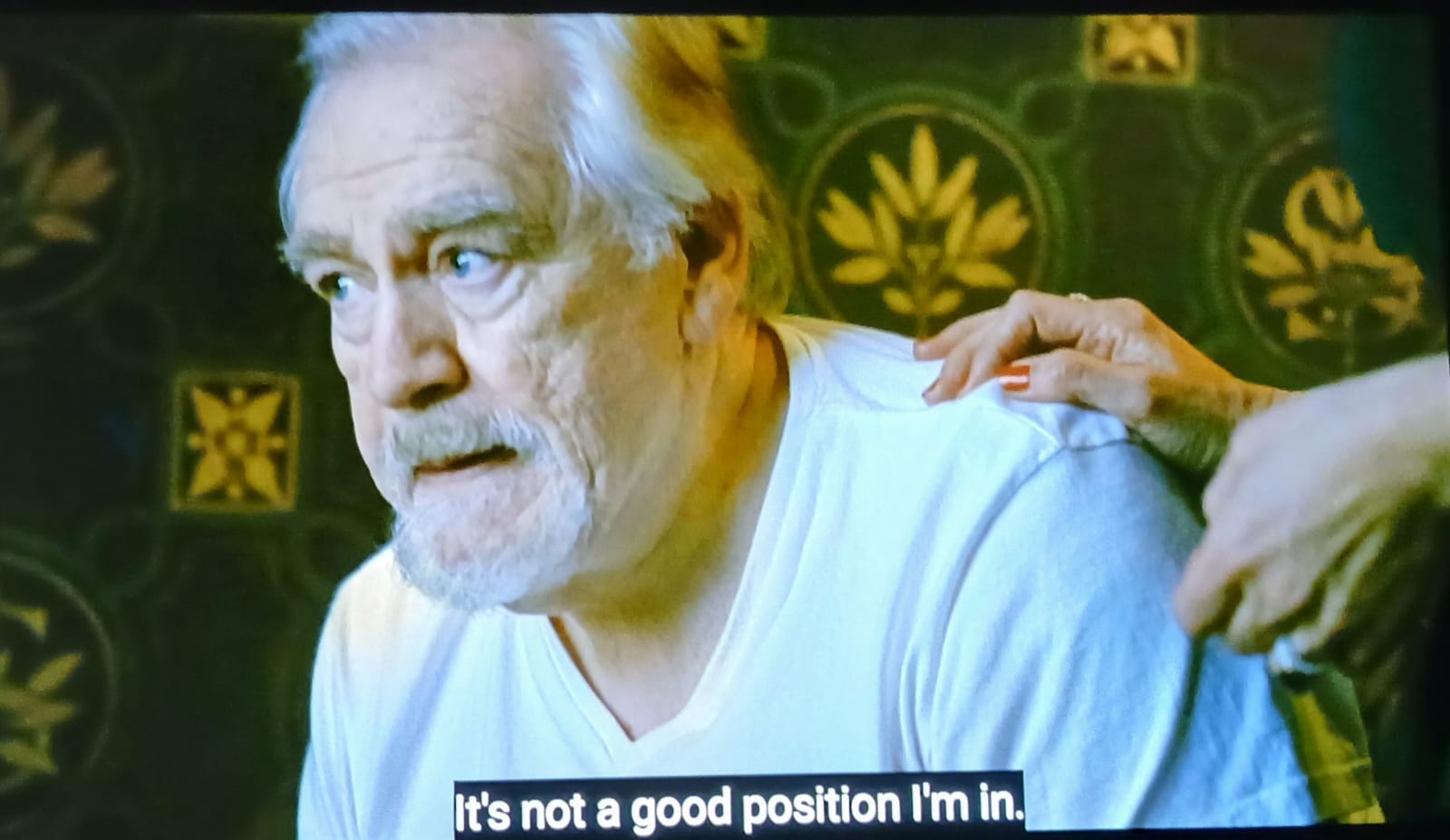
A lot of people come to the Dream Songs via DS14 (‘Life, friends, is boring’), a phrase from which gives this Substack its name; and DS29 (‘There sat down once a thing on Henry’s heart’), which has furnished epigraphs for so many other writers, as well as the titles of the four series finale episodes of the hit HBO show Succession. (Jesse Armstrong also slid in a reference to DS28, as seen in the image above.) Berryman has a wide variety of passionate fans - ‘Berrymaniacs’, in John Haffenden’s lovely coinage - even though his general reputation has declined significantly since his death, for a number of reasons (and, again, there will be a full post on that. Reputation mattered greatly to Berryman, arguably, too much: an anxiety that noticeably, indeed unignorably, marks several of the 77 poems).
So I don’t know how often 77DS gets read as a book these days. I don’t just mean cover-to-cover, though that in itself is probably not common. I mean as a single work, conceived and curated, a composition whose parts all talk to each other, relate to each other: one where, over the course of the book, things develop, complicating or clarifying earlier moments. Where every local detail is also part of a larger whole.
Berryman wrote hundreds of Dream Songs. His Toy, His Dream, His Rest, containing 308 more, was published in 1968, only a few years after 77DS; and another tranche of 152 (!) previously uncollected poems has been released very recently (under the title Only Sing). I agree with Adam Kirsch, who writes brilliantly about Berryman, that the larger outpouring offers diminishing returns: ‘For it is this initial collection that marks Berryman’s zenith as a poet, and the 300-plus poems that followed it can have the effect of diluting and domesticating its achievement’. The form was a breakthrough for him, but also, perhaps, a trap.
And when he first gathered the 77 - ‘turning it over, considering like a madman, / Henry put forth a book’ (DS75) - he agonized over his choices, and their arrangement. That ‘turning it over’ is nice, isn’t it? - it means ‘thinking it through’, but also conjures an image of manic fidgeting with all those sheets of paper. And also the act of releasing the book, of ‘turning it over’ to someone else.
Berryman was never going to be able to make all the Dream Songs cohere, and his later rationalisations were, with the best will in the world, mostly bogus. But nonetheless, 77DS was sent out, received, and rewarded, as a book. So what was – is – that book? Sixty years on we have so many distracting layers and encrustations of biography, letters, critical studies and so on (‘Now he has become ... an industry’, as Berryman wrote of Frost) , that retrieving the original book requires suppressing and ignoring those ‘Outer Resources’ and using – as far as possible – only what is there.
This may seem a quixotic endeavour. A pal of mine says that my general (and heartfelt) antipathy to biographical readings of any author is merely a product of the period in which I studied English literature at university, an accident of timing, of fashion. I’m not so sure.
One of my very favourite of the songs is DS71, about Henry’s audience, with its defensive line ‘It was not, so, like no one listening / But critics famed, and Henry’s pals, or other tellers at all / Chiefly in another country. No.’ (That well-placed ‘so’ and the echoing ‘no’ always make me smile, with their frisson of poutiness.) And this is not the only poem in which Henry isn’t thrilled that (like any prophet or hip priest) he is not appreciated in his own country.
Initial reviews by critics famed, Henry’s pals (Robert Lowell, for example), and other tellers at all, etc (eg Eric Mottram in the TLS), got elements of 77DS wildly, terribly wrong. But was that their fault? It was years later, as a result of widespread readerly confusion, that Berryman offered a partially clarifying paragraph about the different voices: ‘The poem then, whatever its cast of characters, is essentially about an imaginary character (not the poet, not me) named Henry, a white American in early middle age sometimes in blackface, who has suffered an irreversible loss and talks about himself sometimes in the first person, sometimes in the third, sometimes even in the second; he has a friend, never named, who addresses him as Mr Bones and variants thereof.’
But my hard line on this is that – as we have often been reminded, by writers and thinkers from Socrates to Derrida and onwards – a book goes out into the world alone, without its author to hold its hand and make excuses for it. I don’t trust Berryman’s remarks on his own poem, and I don’t in any case want to rely on them. The (prizewinning) book must speak for itself.
There will be times in these posts, nonetheless, when I do draw on some of those Outer Resources, if only for entertainment or harmless colour. I’ll flag them up as such. And there’ll be times that I will suggest that, even in a work of such deliberate discordance, dissonance and disguise, Berryman has at times simply made a mistake – for example with a word or line which doesn’t work, on any terms. But mostly, I’ll use ‘Inner Resources’, in good faith, to argue that 77DS works, and works triumphantly, as a whole. We will try to recover a sense of being a reader in 1964, knowing nothing of Berryman himself, and getting to grips with a remarkable and highly original book. We will resemble the men, women and children in the allegorical scene that Berryman (self-mockingly) proposes in DS75, which I quoted from earlier. In this poem, the book which Henry ‘put forth’ has become, in a dreamy metamorphosis, a tree. (Normally it’s trees that become books, it now occurs to me.) And – great oaks from little acorns grow – gradually it attracts admiring attention:
Something remarkable about this
unshedding bulky bole-proud blue-green moist
thing made by savage & thoughtful
surviving Henry
began to strike the passers from despair
so that sore on their shoulders old men hoisted
six-foot sons and polished women called
small girls to dream awhile toward the flashing & bursting tree!
The next Inner Resources post will be a preliminary overview of ‘surviving Henry’ and his identity as, specifically, a writer. Thereafter posts will either be attempts to read individual poems (starting, sensibly, with DS1, and probably staying there for some time while radiating out across the book; but then more random, ‘directionless and lurchy’, as it were), or thematic – cinema, animals, ‘the world’, race, forms of address, music, etc. Wherever this takes us, we happy few, I hope it’ll be fun.
I'm delighted at this. I've always loved - admired is too cold for Berryman - his fluency with that form & rhythm.
Congratulations on such a prodigious feat of memory! I’m really looking forward to reading your Substack, Robert. It seems to me that just as American C20 novelists wanted to write The Great American Novel, so a handful of C20 American poets wanted to write The Great American Poem - so Ezra Pound and The Cantos, WCW and Paterson, Robert Lowell and those ‘fourteen liners’ collected in Notebook, History, For Lizzie and Harriet, and The Dolphin, AR Ammons and Tape For The Turning Of The Year. Nor is this field entirely populated by men: Anne Stevenson’s Correspondences is also a worthy contender for ‘The Great American Poem’. I think some of these poets did truly achieve a peculiarly American as opposed to European kind of poetic greatness - WCW, Berryman, and AR Ammons to be specific. However, I think the others mentioned here - even though their work undoubtedly is great - do not quite achieve greatness ‘in the American grain’. Your reflections on ‘Greatness’ in this American context would be be very welcome, Robert.