
'And empty grows every bed'
In which we dig a little deeper, and bring up the bodies

His mother goes. The mother comes & goes.
Chen Lung’s too came, came and crampt & then
that dragoner’s mother was gone.
It seem we don’t have no good bed to lie on,
forever. While he drawing his first breath,
while skinning his knees,
while he was so beastly with love for Charlotte Coquet
he skated up & down in front of her house
wishing he could, sir, die,
while being bullied & he dreamt he could fly —
during irregular verbs — them world-sought bodies
safe in the Arctic lay:
Strindberg rocked in his niche, the great Andrée
by muscled Fraenkel under what’s of the tent,
torn like then limbs, by bears
over fierce decades, harmless. Up in pairs
go we not, but we have a good bed.
I have said what I had to say.
Preamble: As you were. Apologies for yesterday’s diversion. So, once more, with less feeling… This is not an easy poem, I think it is safe to say, but nor is it as hard as it looks, especially in the light of our work to date. Indeed, in John Berryman: A Critical Commentary (1980) by Legendary Head Berrymaniac John Haffenden, there is over a page on DS11, precisely to suggest that once the references are located – largely publicly available, though he does admit a minor biographical note – the ‘difficulties and obscurities of 77 Dream Songs are more apparent than real’. I aim to set out those names and references, then suggest a reading not far from Haffenden’s but with more attention to certain details, and will then winningly suggest that the poem is a deliberate mirror of DS6, which we covered here.
Music: By far the most effective sonic properties here are the propulsive series of ‘while’ clauses. (‘While’ is used 23 times in 77DS, rarely more than once in a poem, but 4 times alone in DS6 and 4 times in DS11.) The rhyme scheme is interesting: lines 3 and 4 in each stanza rhyme perfectly (‘gone’, ‘on’; ‘die’, ‘fly’; ‘bears’, ‘pairs’), and lines 1 and 6 nearly so (‘goes’, ‘knees’; ‘Coquet’, ‘lay’; ‘Andrée’, ‘say’). So, it would be a chiasmus, abccba, were it not that, in every case, lines 2 and 5 do not rhyme (‘then’, ‘breath’; ‘house’, ‘bodies’; ‘tent’, ‘bed’). Other repetitions are our old friend ‘come’ (or ‘came’) and – topping and tailing the poem – ‘bed’. Bed, as we know, is an important word in 77DS, and never more so than in this poem.
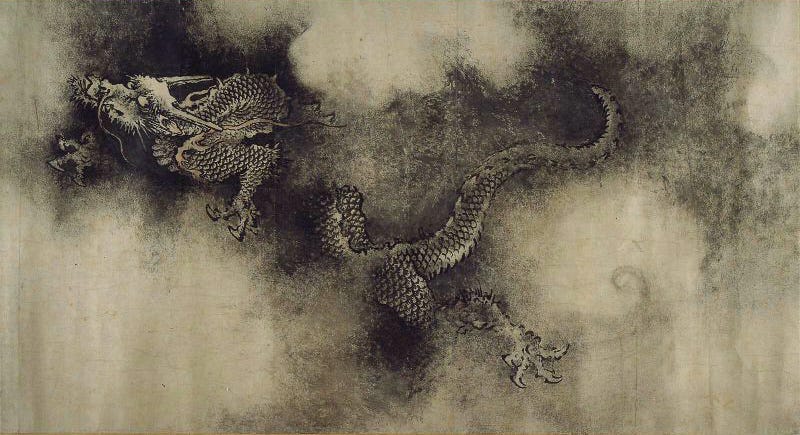
References: ‘Chen Lung’ should be ‘Ch’en Jung’, thinks Haffenden, and is surely right – one of the perils of transliteration, I guess, and indeed, Wikipedia favours ‘Chen Rong’. He was a thirteenth-century Chinese painter, famous for his depictions of dragons. I cannot find any corroboration for a further speculation of my own, that in DS30 Berryman describes another painting from that artist (or at least that period), this time with a tiger in it: ‘A tiger by a torrent in rain, wind, / narrows fiend’s eyes for grief / in an old ink-on-silk’.
‘Charlotte Coquet’: Haffenden says (Outer Resources) that she was a classmate of Berryman’s, and a later biographer Paul Mariani says so too. I was disappointed by this – another reason to dislike biographical info – because I assumed that it was a made-up name intended to evoke the word ‘coquette’.
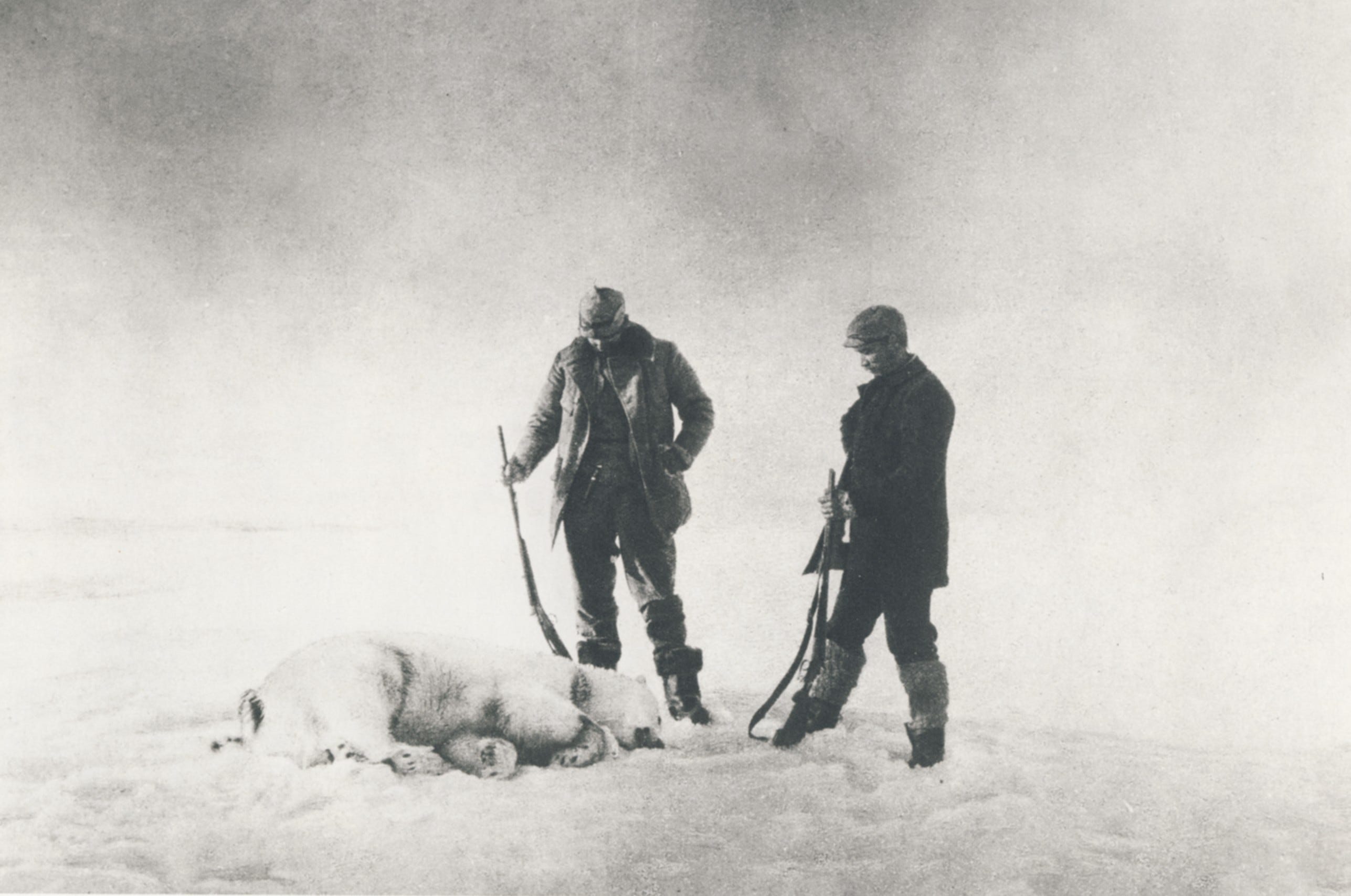
‘Strindberg … Fraenkel’: This is a corking story, of which I was wholly unaware. Salomon Andrée was a late nineteenth-century Swedish engineer and balloonist who, with Knut Fraenkel (also an engineer) and Nils Strindberg (a young scientist and photographer), set off in 1897 to reach the North Pole in a hydrogen balloon. The expedition failed for a number of reasons, hubris being one of them. The balloon crashed within days. ‘Free flight lasted for 10 hours and 29 minutes and was followed by another 41 hours of bumpy riding with frequent ground contact before the inevitable final crash.’
Thereafter, ill-equipped and ill-prepared, the explorers wandered the icy landscape ineffectively, ending up on a deserted island (White Island) in Svalbard, where they all died. Their bodies were not discovered until 1930. The causes of death have been contested over the years. Strindberg would appear to have died first and been buried in an aperture in the rocks, covered with stones (‘rocked in his niche’): a large number of his photographs survived. Fraenkel may have died next, and it is possible that Andrée then committed suicide. The bodies had indeed been gnawed by bears, but probably posthumously.
The poem: DS11 is about various beds; it starts with the suggestion that ‘It seem we don’t have no good bed to lie on, / forever’, and ends with the suggestion that ‘Up in pairs / go we not, but we have a good bed’. But they are not the same bed.
Maybe, pace my earlier post on this poem, ‘the mother … goes’ does not have to mean death, but does mean separation. We move from childbed to the very first independent act of a baby, the drawing of first breath; to the skinning of knees (when maternal care is often still present); to (in Freudian terms) the transfer of libidinal attachment from parents to others (Charlotte Coquet). The torments of Henry’s adolescence – lust, and being bullied – imply the receding of adult care and oversight. Henry wants to die or fly to get out of his intolerable situations (both words, interestingly, linked to the doomed polar expedition).
And all the while, Chen Rong's dragon paintings survive, and the frozen corpses of Salomon Andrée’s doomed balloon trip also endure. But unlike immortal art, the balloonists are bear-nibbled, and in a cruel parody of infancy the younger man, Strindberg, is ‘rocked’ (wedged in with stones) in his crib-like niche, while in a cruel parody of the marriage bed, Andrée and Fraenkel lie next to each other. So, up (to bed) in pairs go we not – not with parent or lover – but alone to the death bed. Forever.
Haffenden rightly picks up on ‘safe’ and ‘harmless’ in lines 12 and 16:
During that period, when he was growing up, the three explorers were literally dead, and accordingly, in Berryman’s terms, enjoyed a paradoxical security (like childhood in that respect alone) because of being ‘safe’ from the depredations of time, immortalised in ice and so immutable. The bears that marauded their bodies were, strictly speaking, ‘harmless’ to them. While Berryman grew through childhood, safe in a different way, cared for by his mother, those men transcended time altogether, unknown to him.
It is at this point that one might wonder about the role of Chen Rong in all of this. It is, I think, and as Haffenden thinks, about a different form of survival:
Similarly, Ch’en Jung has passed not only beyond the time of his childhood, made secure by his own mother, but he too has transcended all time in the passage of several centuries, and shares the notional time of death with the explorers.
One is reminded of the ‘grapes of stone’ in DS6, persisting down the centuries. And in fact, the two poems are surely deliberately paralleled. We had ‘the father’s … his father’ in DS6; we have ‘His mother … The mother’ in DS11. We have the word ‘while’ four times in each, as part of a paralleling of comings-and-goings against a changeless piece of art.
We also have some syntactical trouble in both poems, always a sign in 77DS – we know this by now, don’t we? – of a subject which Henry is struggling to cope with. In DS11 it is the final passage: ‘under what’s of the tent, / torn like then limbs’. I think the missing word is ‘left’ (‘under what’s [left] of the tent’) and I think the messed-up word is ‘then’ and it should be ‘their’ (‘torn like [their] limbs’). Well, one could be fanciful here (and why not? Where’s the harm?) and say the word ‘left’ is difficult for Henry because it is about abandonment (‘my father / who dared so long agone leave me’, DS76), and that a possessive is turned into a temporal term (‘their’ to ‘then’) for similar reasons. But I am certain that some of you will have better, stronger ideas than that.
‘I have said what I had to say’ might be read in two contradictory ways – I have said what I wanted to say; I have said what I was compelled to say. It is one of a number of moments in DS77 when Henry refers self-reflexively to his own performance. Is it an acknowledgement that the previous line is at once a firm conclusion and yet also slightly and deliberately opaque? Henry’s mind has moved from childbirth to adolescence and art, but behind these thoughts lay the frozen bodies. DS77 often flinches a little when death comes into view. A third reading: I have said all I am going to say.
Before I go – thank you, as always, for sticking with this ultra-niche deep dive, especially those of you who comment (including my professorial pal Alan, whose ‘long agone’ PhD thesis I recently went in search of, and found instead a new friend). And sorry (not sorry) about some of the detours and, ahem, uncharacteristic digressions. But we are here at least partly to have fun, and I hope we will continue to do so. Next time, indeed, we will get a teeny bit Halloweeny, and return (hurrah!) to the movies. I feel y’all deserve it after the past couple of poems, which have been heavy on the heart, in so many ways. This week’s song is performed by Howard Devoto, and comes from the collaborative album It’ll End in Tears by This Mortal Coil.
Your wonderful deep readings of these poems, which I didn't know, have sometimes brought to my mind favourite scraps of other poetry in some opaque relation. This time what came to me was Ariel's luring Ferdinand with the image of a drowned Alonso, turned to coral with pearls for eyes, and Alonso himself trying to reconcile with the idea of his son "drowned, whom thus we stray to find". Why did I think of this? I suppose because of the Arctic explorers preserved in ice; but also the poignant power of "thus we stray to find" maybe here an apt image for rich, digressive exploration! Quite separately the idea of saying all one had to say made me think of a line from a lyric we both like, "thought I'd something more to say". It's great that you still have plenty more to say!
I am delighted to be your pal trailing you on this expedition, feet safely on the ground. I like your sense of the die/fly rhyme linking up with the fate of the balloonists. "Drawing" works in the same way with Chen Lung. "Sir" planted in the middle of his teenage death-wish seems to be a nod to his father. Another layer to lines 14-15, though a stretch: the present tense "what's" versus what once were limbs. Having written that out, it now strikes me as too fussy.